
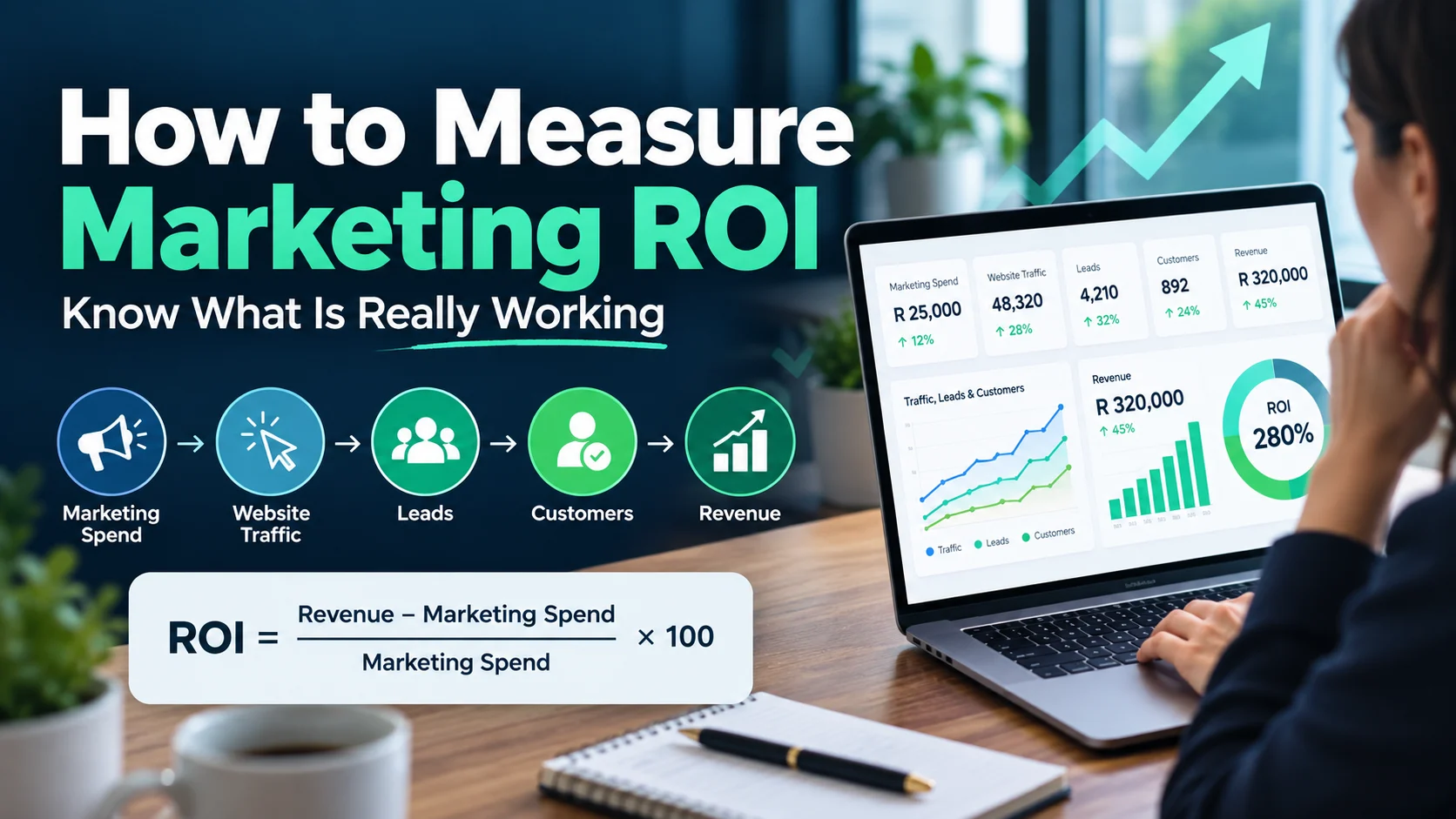
Your business may be investing in SEO, Google Ads, social media, content and website improvements—but can you confidently identify which activities are generating qualified leads, customers and revenue?
Marketing ROI measurement helps connect marketing activity to commercial outcomes, giving you stronger evidence for deciding where to increase budget, where to optimise and where to stop spending.
What Is Marketing ROI?
Marketing ROI measures the financial return generated from marketing compared with what the business invested. The goal is to understand whether marketing is producing enough commercial value to justify the cost.
Marketing Activity Is Not the Same as Marketing Performance
Many businesses receive monthly reports filled with traffic, impressions, clicks, followers, engagement rates and keyword positions.
Those numbers can be useful, but they do not automatically answer the most important commercial question:
“What did our marketing investment actually contribute to the business?”
ROI Turns Marketing Data Into Better Business Decisions
When marketing performance is measured properly, management can move beyond assumptions and make budget decisions using evidence.
How Do You Calculate Marketing ROI?
A simple marketing ROI formula compares the return attributed to marketing with the cost of generating that return.
(Return from Marketing − Marketing Cost) ÷ Marketing Cost × 100
A Simple South African Example
Imagine your business spends R20,000 on a marketing campaign and can attribute R60,000 in return to that activity.
The calculation is: (R60,000 − R20,000) ÷ R20,000 × 100 = 200%. In this simplified example, every R1 invested generated R3 in total return, including the original R1 invested.
Should Marketing ROI Use Revenue or Profit?
This is where marketing ROI measurement can become more nuanced. Some businesses calculate returns using revenue, while others prefer gross profit or contribution margin.
The most important requirement is consistency. If you compare campaigns or channels, make sure the same method is used across each calculation. For businesses with significant cost of goods or delivery costs, profit-based calculations may provide a more meaningful picture than revenue alone.
Marketing ROI and ROAS Are Not the Same Thing
Return on Investment
Looks at the broader relationship between marketing costs and the value or profit generated.
Best for: Overall commercial performanceReturn on Ad Spend
Usually compares revenue generated by advertising directly with the amount spent on that advertising.
Best for: Paid advertising efficiencyGood Reporting Should Follow the Customer All the Way to Revenue
The further your reporting travels through the customer journey, the more commercially useful your marketing data becomes.
Define What Counts as a Conversion
ROI measurement starts by defining the actions that indicate genuine commercial interest. The right conversion depends on how your business sells.
Track Where Every Lead Came From
Knowing that you received 100 enquiries is useful. Knowing which channels produced those enquiries is much more valuable.
Analytics, advertising platforms, tagged URLs, call tracking and CRM data can help connect enquiries to channels such as SEO, Google Ads, social media, email or referral traffic.
Measure Lead Quality, Not Just Lead Volume
A campaign generating 100 enquiries is not automatically better than one generating 25. The quality of those enquiries matters.
Connect Marketing Leads to Sales Outcomes
Marketing reporting should not stop when someone submits a form.
To understand ROI properly, the business needs to know what happened next. Was the lead qualified? Was a proposal sent? Did the opportunity close? How much revenue did it generate?
What Should Be Included in Marketing Cost?
The exact calculation depends on what you are measuring, but marketing investment can include more than media spend alone.
Which Marketing Metrics Actually Matter?
Different metrics answer different questions. Strong marketing reporting keeps them in context instead of treating every number as equally important.
| Stage | Useful Metrics | What They Tell You |
|---|---|---|
| Awareness | Reach, impressions, engagement | Whether people are seeing and interacting with marketing |
| Traffic | Sessions, clicks, CTR, CPC | How effectively marketing brings people to your digital properties |
| Lead Generation | Conversions, CPL, conversion rate | How efficiently traffic becomes enquiries |
| Sales | Qualified leads, opportunities, close rate | Whether leads have genuine commercial potential |
| Profitability | CAC, ROAS, revenue, marketing ROI | Whether marketing makes financial sense |
Big Numbers Do Not Always Mean Strong Results
Activity Metrics
Commercial Metrics
Marketing ROI Measurement Looks Different Across Channels
SEO ROI
Track organic traffic, rankings, organic conversions, qualified leads and revenue generated from customers who discovered the business through search.
Google Ads ROI
Compare ad spend with conversions, cost per lead, qualified opportunities, customers and attributed revenue.
Social Media ROI
Separate brand-building activity from lead-generation campaigns and measure traffic, assisted conversions, direct leads and paid social performance accordingly.
Website Performance
Measure conversion rates, enquiries, calls, bookings and how effectively the website helps traffic from every channel become opportunities.
Email Marketing ROI
Look beyond open rates and measure clicks, conversions, sales opportunities and revenue generated by email campaigns and automated sequences.
Content Marketing ROI
Track search visibility, relevant traffic, assisted conversions, enquiries and the role content plays in moving prospects toward a decision.
Customers Rarely Use Only One Marketing Touchpoint
A buyer might first see your company on LinkedIn, later read a blog article, return through Google, click a paid ad and finally submit a quote request. That makes marketing attribution more complicated than simply assigning every sale to the final click.
First-Click Attribution
Gives credit to the first marketing source that introduced the customer to the business. Useful for understanding discovery, but it may ignore later interactions that influenced the sale.
Last-Click Attribution
Gives credit to the final tracked source before conversion. Simple to understand, but it can undervalue earlier marketing activities that helped build awareness and trust.
No attribution model is perfect. The goal is not absolute certainty. It is to build enough reliable evidence to make better marketing decisions.
A Marketing Dashboard Should Help Management Make Decisions
The best reports do not simply present numbers. They explain what happened, why it matters and what should happen next.
What did we invest?
How many enquiries resulted?
Were they commercially relevant?
How many converted?
What value did they generate?
Your Marketing Measurement May Need Work If…
Questions to Ask Every Month
Every Channel Should Lead to One of Three Decisions
Scale
Increase investment where results are strong and additional demand can be captured profitably.
Optimise
Improve targeting, conversion rates, creative, messaging or follow-up where potential exists.
Reconsider
Reduce or redirect investment where performance consistently fails to justify the spend.
Marketing Should Be Measured by More Than Activity
BlinkNow helps businesses connect marketing activity to meaningful commercial outcomes so decisions around SEO, paid advertising, content, social media and website optimisation can be based on evidence rather than assumptions.
That means looking beyond traffic and engagement to understand how marketing contributes to enquiries, lead quality, sales opportunities and business growth.
Don’t Just Ask, “Did Our Traffic Increase?”
Ask, “Did our marketing create profitable opportunities for the business?”
Effective marketing ROI measurement connects spend to traffic, traffic to conversions, conversions to qualified opportunities and opportunities to customers and revenue. The data does not need to be perfect—but it needs to be good enough to support better decisions.
Do You Know Which Marketing Channels Are Actually Working?
If your reports show clicks, impressions and website traffic but you still cannot clearly identify which activities are producing qualified opportunities, BlinkNow can help review your tracking, conversion journey and marketing performance.
Get a Marketing Performance Assessment → Explore BlinkNowMarketing ROI Measurement FAQs
What is marketing ROI?
Marketing ROI measures the return generated from marketing compared with the amount invested. It helps businesses understand whether marketing activity is producing enough commercial value to justify its cost.
What is the formula for calculating marketing ROI?
A common formula is: return from marketing minus marketing cost, divided by marketing cost, multiplied by 100. Businesses should clearly define whether the return figure is based on revenue, gross profit or another financial measure.
What is the difference between ROI and ROAS?
ROAS generally compares advertising-generated revenue directly with advertising spend. ROI is broader and can include other marketing costs while focusing on the overall financial return generated from the investment.
How do you measure SEO ROI?
SEO ROI can be measured by tracking organic traffic, conversions, qualified leads, customers and attributed revenue, then comparing the resulting value with the cost of SEO activity over the relevant period.
Which marketing metrics are most important?
Useful metrics depend on the business objective, but commercially important measures often include qualified leads, conversion rate, cost per lead, customer acquisition cost, sales opportunities, revenue, ROAS and marketing ROI.
Can marketing ROI be measured perfectly?
Not always. Customers may interact with several channels before buying, and some brand-building activity is difficult to attribute precisely. The objective is to create a reliable enough measurement system to support better decisions rather than expecting perfect attribution.