Quick answer: Digital marketing is the promotion of products, services, or brands through online channels — search engines, social media, email, websites, and paid ads. Unlike traditional marketing (print, TV, billboards), it lets you target specific audiences, measure every click, and adjust campaigns in real time.
If you’ve searched “digital marketing meaning” and found nothing but jargon, this guide is for you. I’ll explain what digital marketing actually is, break down the main types with real examples, and show you how to get started — whether you want to learn it as a skill or use it for your business.
Digital Marketing Definition (In Plain English)
Digital marketing definition: any marketing activity that uses the internet or an electronic device to reach customers.
That’s it. When a business:
- Shows up on Google when you search for a product → that’s digital marketing (SEO or paid search)
- Runs an ad in your Instagram feed → digital marketing (social media advertising)
- Sends you a discount email → digital marketing (email marketing)
- Publishes a helpful blog post that answers your question → digital marketing (content marketing)
The core difference from traditional marketing is measurability and targeting. A billboard reaches everyone who drives past it. A digital ad can reach only 25–34-year-old gardening enthusiasts in one city — and tell you exactly how many clicked, and how many bought.
Digital Marketing vs. Online Marketing — Same Thing?
Mostly, yes. “Online marketing,” “internet marketing,” and “e-marketing” are used interchangeably with digital marketing. Technically, digital marketing is slightly broader — it includes channels like SMS and digital billboards that don’t require the internet — but in everyday use, treat them as synonyms.
The 8 Main Types of Digital Marketing
Here’s the breakdown every beginner needs. Each type is a channel; most real strategies combine several.
1. Search Engine Optimization (SEO)
Optimizing your website so it appears in unpaid (organic) search results. When someone searches “best coffee shop near me” and your site appears without paying for the click — that’s SEO. It covers on-page content, technical site health, and backlinks. Slow to build, but delivers the cheapest long-term traffic. It’s also our core specialty — see our SEO services, from keyword research to link building.
Example: A plumbing company publishes a guide on “how to fix a leaking tap” and ranks #1, bringing in hundreds of local visitors monthly at zero ad cost.
2. Pay-Per-Click Advertising (PPC)
Paid ads on search engines and other platforms where you pay each time someone clicks. Google Ads is the biggest player. PPC delivers instant visibility — you can be on page one within hours — but traffic stops the moment you stop paying. Managed poorly, PPC burns budget fast, which is why campaign management matters — that’s what our PPC advertising service handles.
Example: An e-commerce store bids on “buy running shoes online” and pays per click to appear above organic results.
3. Social Media Marketing
Building an audience and promoting on platforms like Instagram, Facebook, TikTok, LinkedIn, and YouTube — through both organic posts and paid ads. B2C brands lean on Instagram/TikTok; B2B brands get better results on LinkedIn. If you’d rather not manage this daily, our social media marketing service covers strategy, content creation, and community management.
Example: A skincare brand posts before/after videos on TikTok, then retargets viewers with a discount ad.
4. Content Marketing
Creating valuable content — blog posts, videos, guides, tools, podcasts — that attracts and educates your audience rather than directly selling. Content marketing fuels SEO and social media; it’s the engine behind them. Our content marketing and blog writing services exist for exactly this reason.
Example: A software company publishes free templates and tutorials. Readers trust the brand and eventually buy the paid product.
5. Email Marketing
Sending targeted messages to people who opted into your list — newsletters, promotions, abandoned-cart reminders. Consistently one of the highest-ROI channels because you own the audience (no algorithm decides who sees your message). Explore our email marketing service if you want campaigns set up and automated for you.
Example: An online store emails “You left something in your cart — here’s 10% off,” recovering sales that would otherwise be lost.
6. Affiliate Marketing
Paying partners (affiliates) a commission for each sale they generate through their unique link. Common with bloggers, YouTubers, and comparison sites.
Example: A tech reviewer links to a laptop on Amazon and earns a percentage of every purchase made through that link.
7. Influencer Marketing
Partnering with people who have engaged audiences to promote your product. Ranges from celebrity deals to micro-influencers with 5,000 loyal followers in a niche.
Example: A fitness supplement brand sponsors a gym YouTuber to feature its product in workout videos.
8. Display & Video Advertising
Banner ads, video ads, and native ads shown across websites, apps, and platforms like YouTube — usually for brand awareness and retargeting.
Example: After you visit a hotel website, you see that hotel’s banner ads on news sites for the next week. That’s retargeting display advertising.
How Does Digital Marketing Work?
Every effective digital marketing strategy follows the same loop, regardless of channel:
- Define the goal — leads, sales, sign-ups, or brand awareness.
- Identify the audience — who they are, what they search for, where they spend time online.
- Choose channels — match channels to the audience (e.g., LinkedIn for B2B decision-makers, TikTok for Gen Z consumers).
- Create and launch — content, ads, emails, landing pages.
- Measure — track clicks, conversions, and cost per result using tools like Google Analytics.
- Optimize and repeat — cut what’s not working, scale what is.
This measure-and-adjust loop is what separates digital from traditional marketing. In my own client work, it’s normal to test two ad versions, find one converts at half the cost, and shift the entire budget within a week — something impossible with a print ad.
A Simple Digital Marketing Strategy Example
A local gardening supplies store wants more online sales:
- SEO + content: publishes seasonal planting guides targeting searches like “when to plant tomatoes”
- Email: collects emails via a free planting calendar download, sends weekly tips with product links
- Social: posts short garden-transformation videos on Instagram and Facebook
- PPC: runs Google Shopping ads on high-intent searches like “buy compost online”
Four channels, one goal, each feeding the others. That’s what a real strategy looks like — not “post on every platform daily.”
What Does a Digital Marketer Do?
Day to day, a digital marketer typically:
- Researches keywords and audiences
- Writes or briefs content and ad copy
- Manages campaigns in platforms like Google Ads and Meta Ads Manager
- Analyzes performance data and reports on results
- Runs tests (headlines, landing pages, audiences) to improve conversion
Most marketers specialize in 1–2 channels (e.g., an SEO specialist or PPC manager), while generalists coordinate across channels — common in small businesses and agencies.
How to Learn Digital Marketing (Beginner Path)
You don’t need a degree. Here’s the path I recommend to beginners:
- Learn the fundamentals free — Google’s free digital marketing courses and platform certifications (Google Ads, GA4) cover the basics with recognized certificates.
- Pick one channel first — SEO or social media are the most accessible starting points. Depth beats breadth early on.
- Practice on a real project — start a blog, an Instagram niche page, or volunteer for a local business. Employers and clients care about results, not certificates alone.
- Learn the measurement tools — Google Analytics and Search Console are non-negotiable for any channel.
- Expand into adjacent channels — once you can get results in one channel, adding a second (e.g., SEO → content → email) is much faster.
Expect 3–6 months of consistent practice to reach hireable competence in a single channel.
Should You Do It Yourself or Hire an Agency?
- DIY / learn it: best if you’re early-stage, budget-limited, or want the skill itself. Start with SEO and content — low cost, high learning value.
- Hire a freelancer: good middle ground for a single channel (e.g., someone to run your Google Ads).
- Hire an agency: makes sense when you have consistent budget and need multiple channels managed professionally. Evaluate agencies on case studies and reporting transparency, not follower counts or awards.
How WithNova Blink Digital Can Help
If you’d rather have specialists run your marketing while you run your business, that’s what we do at WithNova Blink Digital — a Johannesburg-based digital marketing agency serving businesses across South Africa. We handle every channel covered in this guide under one roof:
- SEO services — audits, on-page and off-page optimization, and backlink generation
- PPC advertising — targeted Google Ads campaigns with conversion rate optimization
- Social media marketing — strategy, content creation, and community management
- Email marketing and content marketing — campaigns that nurture leads into customers
- Web design and development — conversion-focused websites that your marketing sends traffic to
See our success stories and packages, or book a free consultation to talk through your goals.
FAQ: What Is Digital Marketing?
What is digital marketing in simple words?
Digital marketing is promoting products or services through online channels like Google, social media, and email instead of (or alongside) traditional channels like print and TV.
What are the main types of digital marketing?
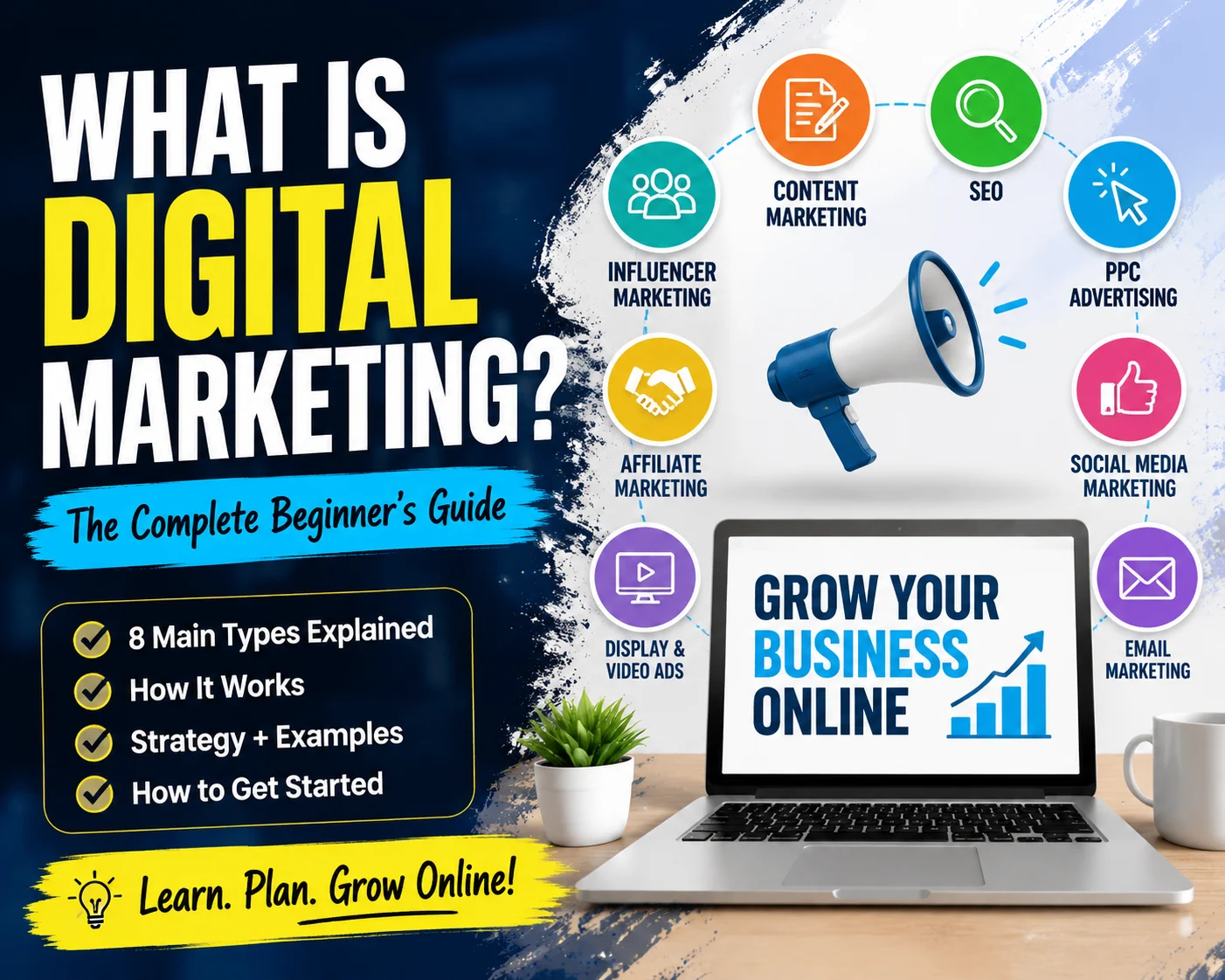
The eight main types are SEO, PPC advertising, social media marketing, content marketing, email marketing, affiliate marketing, influencer marketing, and display/video advertising.
Is digital marketing a good career?
Yes — demand spans nearly every industry, entry barriers are low (skills matter more than degrees), and specializations like SEO, PPC, and analytics offer clear progression paths.
Can I learn digital marketing for free?
Yes. Google’s free courses, platform certifications (Google Ads, GA4, Meta Blueprint), and hands-on practice on your own project can take you to job-ready level without paid courses.
How is digital marketing different from traditional marketing?
Digital marketing is measurable, precisely targeted, and adjustable in real time. Traditional marketing (print, TV, billboards) reaches broad audiences with limited tracking and fixed costs.
How much does digital marketing cost?
It ranges from nearly free (DIY SEO and organic social) to whatever ad budget you set — PPC platforms let you start with small daily budgets. Agencies typically charge monthly retainers — see our digital marketing packages for an idea of typical scope and pricing.
Key Takeaways
- Digital marketing = promoting through online channels with measurable, targeted campaigns
- The 8 core types: SEO, PPC, social, content, email, affiliate, influencer, and display advertising
- Strategy beats channel count: goal → audience → channels → measure → optimize
- Beginners should master one channel on a real project before expanding
Ready to put digital marketing to work for your business? Get a free consultation with WithNova Blink Digital — we’ll map out which channels fit your goals and budget, with no obligation.